
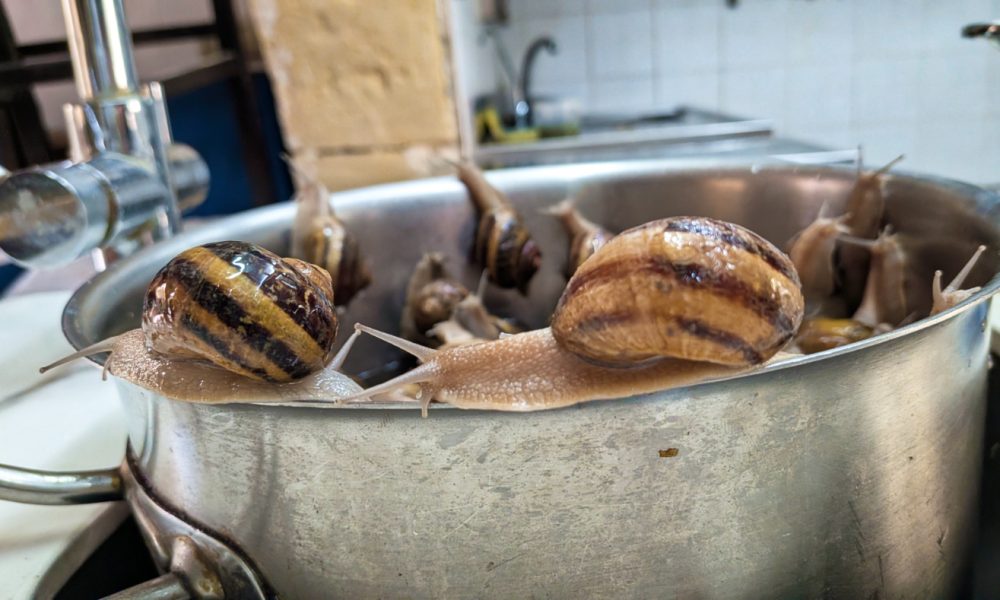
After a long, dry Gozitan summer, the first heavy rain of autumn changes the island overnight. The dust settles, the fields turn green again, and the smell of wet limestone hangs over the rubble walls. For many Gozitan and Maltese families, it is also the signal to go snail hunting.
The tradition is simple and has hardly changed in generations. Usually in October, once the rains arrive, grandparents and grandchildren head out with a basket or a cloth bag and search the places where snails gather: along the dry-stone walls, in the terraced fields and among the rocks and garden beds. During the hot months the snails shelter under stones, sealed inside their shells, and the rain is what brings them out.
The snail people collect is the common brown garden snail (Cornu aspersum, also known as Helix aspersa). It is plentiful on both islands, so foraging it is a seasonal pleasure, not a threat to a rare species.
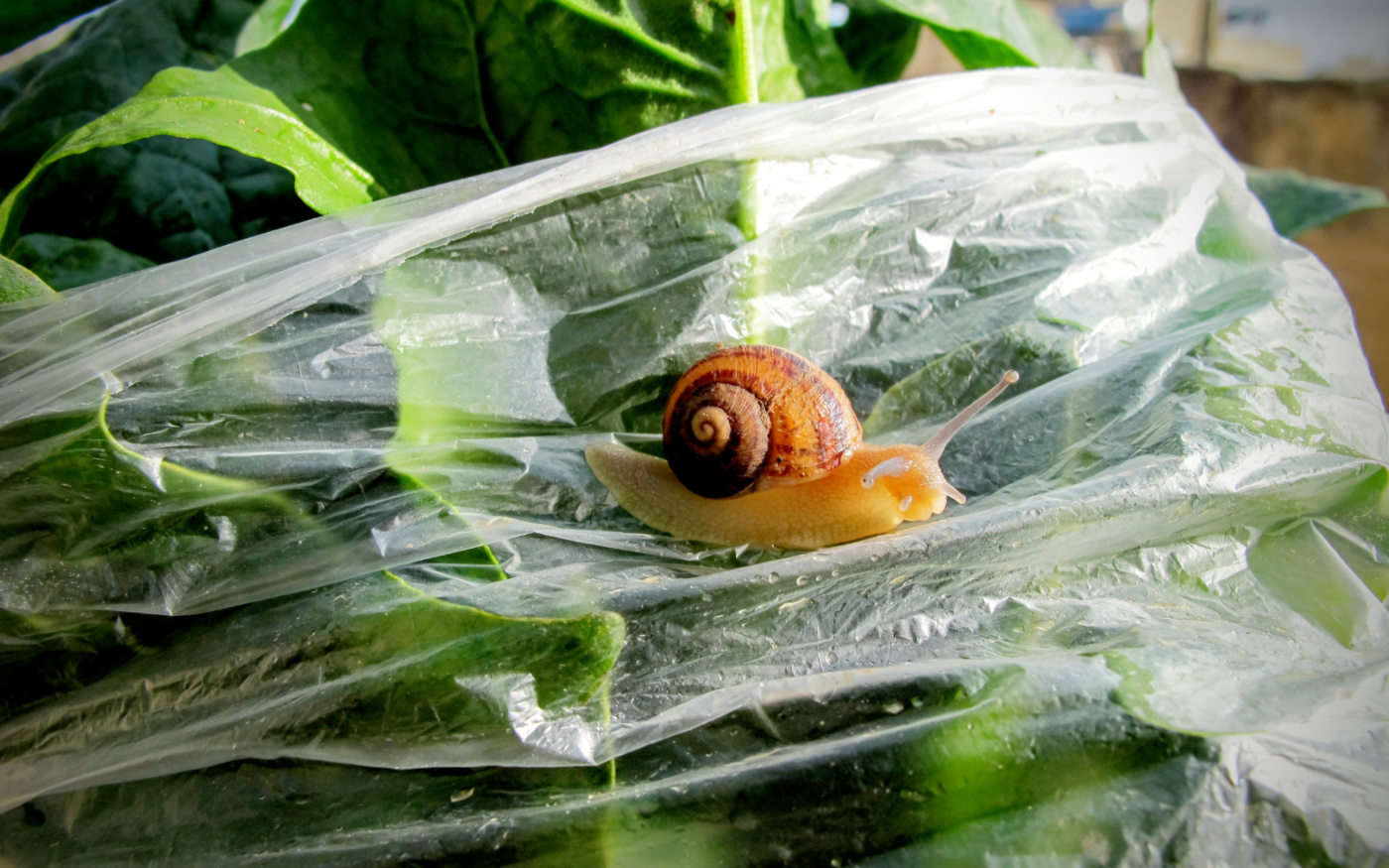
The snails aren’t cooked straight away. Families traditionally let them “fast” for a few days in a covered pot or a net bag, so they clear out whatever they have eaten. They are then washed several times in salted water, boiled, and finished in a sauce.
The best-known dish is bebbux bl-arjoli: snails in a garlicky, gently spiced tomato sauce, served hot with plenty of crusty Maltese bread to mop up the sauce. Some families make a richer stuffat tal-bebbux, a slow stew with onion, tomato and red wine. Others serve snails alongside a fenkata, the rabbit feast that many consider Malta’s national dish. In the past, snails were also a Lenten staple, eaten during the weeks when meat was off the table.
It is honest country cooking, and a true piece of traditional Maltese food. You eat it with a toothpick, your fingers and good bread, and it tastes of the season.
Ask for snails in Malta and you’ll ask for bebbux. Ask a Gozitan, and you may well hear għakrux (said roughly “ah-KROOSH”).
The difference is more than an accent. On mainland Malta, bebbux is the everyday word for any snail. In Gozo, the two words traditionally split the job: għakrux is the land snail, the one you find on the rubble walls after the rain, while bebbux (or bebbuxu) is kept for the sea snail. So in Gozo, the snails in a bowl of autumn pasta are għakrux.
So why the two words? The answer lies in how Gozitan Maltese developed. Gozo is a smaller, more rural island, and for centuries its villages kept their own ways of speaking. The Gozitan dialects held on to words and sounds that faded or changed on the main island. Linguists still record many everyday differences: a Gozitan might say mitraħ for a mattress where a Maltese speaker says saqqu, or fettul for a biscuit instead of biskuttel. Għakrux is one of these island words, and a farming community that knew its land snails and sea snails well had good reason to keep separate names for them.
Both words are old, but they come from different roots:
However you say it, the tradition is shared across both islands. Only the name tells you which side of the Gozo Channel you’re on.
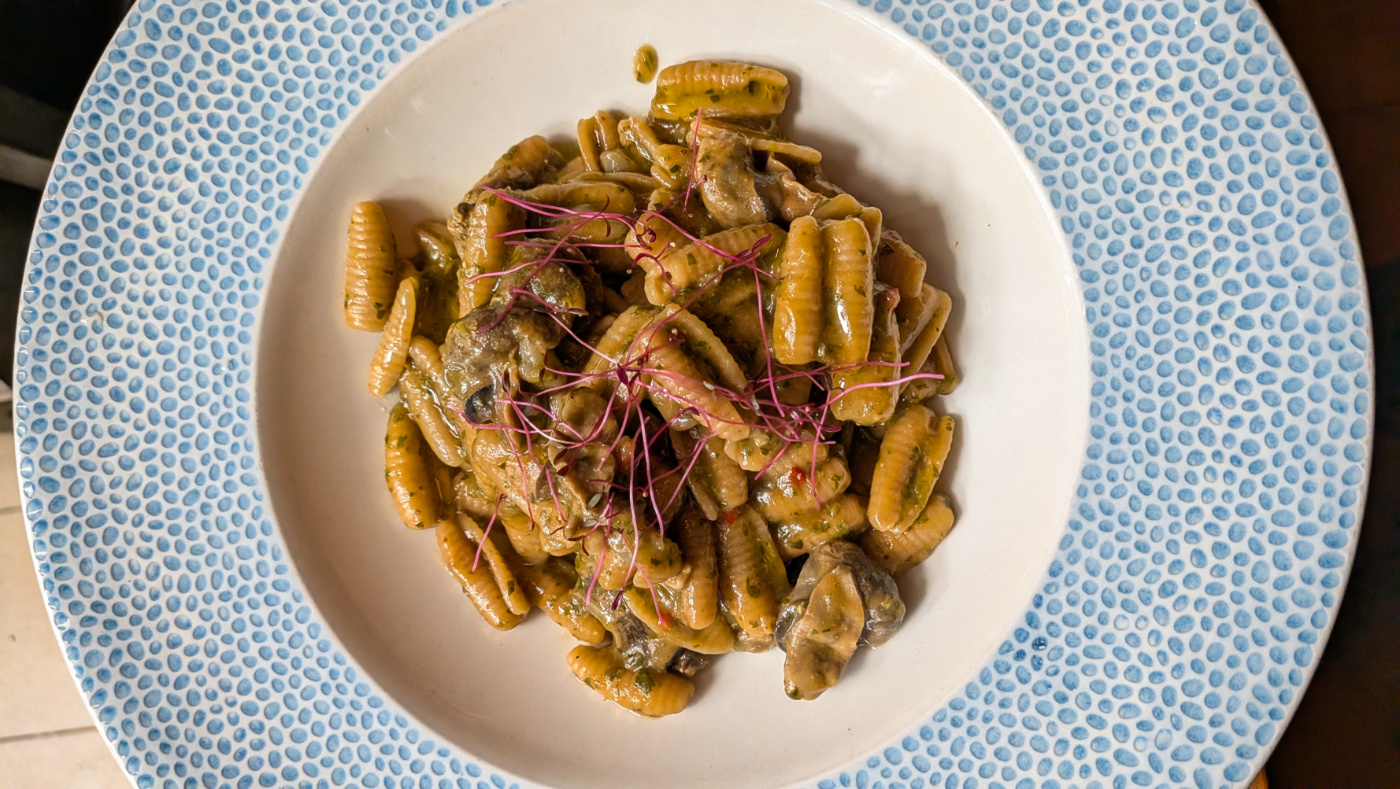
At Maldonado, celebrating Maltese traditions and local produce is part of who we are. That’s why, as the weather turns, snails are on our menu, served as a pasta dish: Cavatelli bl-għakrux.
Our chefs make the cavatelli from rescued sourdough bread made by our former chef Anton from Pastecca. It’s a way to give yesterday’s loaves a second life in the spirit of the thrifty Gozitan kitchen. The pasta is tossed with sautéed snails, onion, garlic, tomato paste, a little chilli, white wine and fresh green herbs. It keeps the soul of bebbux bl-arjoli (garlic, tomato and a gentle warmth) but presents it as a refined plate of pasta. And we kept the Gozitan name on purpose.
It’s a dish that sums up what we do: take traditional Maltese food, treat it with care and technique, and serve it in a setting that matches its history. Our dining room is a 17th-century vaulted limestone cellar in the heart of Victoria, and on a cool autumn evening there are few better places to enjoy it. For many guests, that mix of tradition and craft is what fine dining in Gozo should feel like.
This year it means even more. In 2026 Gozo holds the title of European Region of Gastronomy, awarded by the International Institute of Gastronomy, Culture, Arts and Tourism (IGCAT) in recognition of the island’s food traditions, sustainable practices and cultural heritage. At Maldonado, we’re proud to do our part. We celebrate traditional Gozitan and Maltese cooking at our table, from għakrux to ġbejniet and, in winter, mazzit, while always keeping an eye on the future of dining. That means modern technique, zero-waste thinking like our rescued-bread pasta, and new ways to present the flavours our grandparents grew up with.
Ask our team to suggest a glass from our list of wines of Malta and Gozo to go with it.
Our menu changes with the seasons, so Cavatelli bl-għakrux is here while the snails are.
If you’re in Gozo this autumn, or planning a visit from Malta or further afield, come and taste one of the islands’ oldest seasonal traditions in a new form.
What is bebbux? Bebbux is the Maltese word for snail, and also the name of the traditional dish of snails cooked in a garlic and tomato sauce, often called bebbux bl-arjoli.
What does għakrux mean? Għakrux is the Gozitan word for a land snail. In Gozo, bebbux traditionally refers to sea snails, while on mainland Malta bebbux is used for all snails.
When is snail season in Malta and Gozo? Snails are traditionally collected after the first heavy rains of autumn, usually from October, and the dish is most popular through autumn and winter.
Where can I eat traditional Maltese food in Gozo? Maldonado Bistro in Victoria serves seasonal Maltese and Mediterranean dishes, including Cavatelli bl-għakrux in autumn, in a 17th-century vaulted cellar. Book at maldonado.com.mt.
 Għakrux or Bebbux? Gozo’s Autumn Snail Tradition, from the Fields to Our Table
 Deck the Halls, Our Menu Is Ready!
 Mazzit: Malta’s Sweet Blood Sausage, Now EU-Protected and on Our Winter Menu in Gozo
 From Our Islands to Your Glass: Celebrating Maltese Wine
 Opera Month in Gozo. Three nights. Two operas. One city.